The Daily Baku
International
Why has the US captured Venezuela’s president - and what happens next?
January 5, 2026
14:38
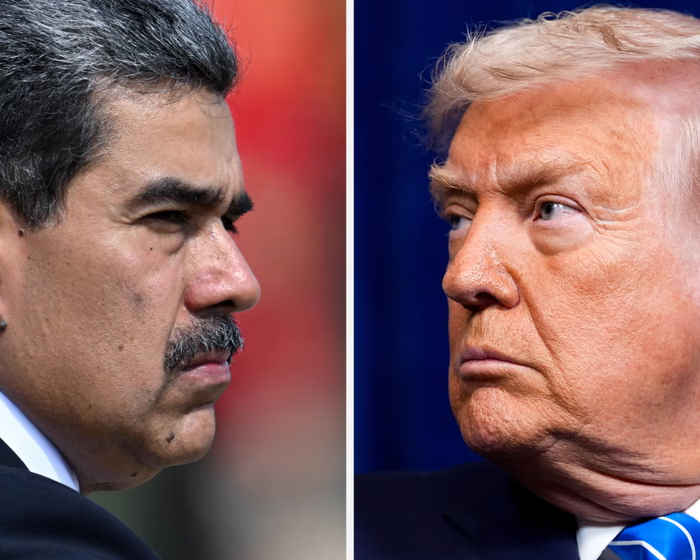
Donald Trump’s seizure of Nicolás Maduro follows months of military escalation and decades of hostility between Washington and Caracas.
The United States launched airstrikes across Venezuela early on Friday, with explosions shaking the capital, Caracas, before dawn. Hours later, Donald Trump announced that US forces had captured Venezuela’s president, Nicolás Maduro, and his wife, Cilia Flores, and flown them out of the country.
“The Daily Baku” reports that, the US attorney general, Pam Bondi, said the couple would face trial in New York on charges related to narco-terrorism, with a fresh indictment unsealed on Saturday. Trump later posted an image on his Truth Social platform captioned “Nicolas Maduro on board the USS Iwo Jima”. The White House subsequently released footage appearing to show Maduro handcuffed and escorted by agents at a US Drug Enforcement Administration facility.
Speaking at a news conference at Mar-a-Lago, Trump declared that the US would “run the country” until a leadership transition could take place, adding that American oil companies would move into Venezuela. “No nation in the world could achieve what America achieved,” he said.
An uncertain power vacuum.
Despite Trump’s assertions, the situation on the ground remains opaque. Venezuela’s military appears to retain control of key installations, and there has been no indication that US forces have occupied Caracas or other major cities.
On Saturday, Venezuela’s supreme court ordered the vice-president, Delcy Rodríguez, to assume the role of acting president during Maduro’s “temporary absence”. Trump later claimed Rodríguez had offered her cooperation to Washington, remarking: “She really doesn’t have a choice.”
Rodríguez is a complex figure within Venezuela’s political system. The daughter of a Marxist guerrilla who gained notoriety for kidnapping a US businessman, she is also a French-educated technocrat who has cultivated ties with economic elites, foreign investors and diplomats.
Trump, meanwhile, dismissed Venezuela’s democratic opposition. He said the Nobel peace prize laureate María Corina Machado lacked the respect and support needed to lead the country, signalling Washington’s unwillingness to back the opposition figures long promoted by European governments.
A campaign of maximum pressure
Since beginning his second term, Trump has placed Maduro firmly in his crosshairs, reviving and intensifying a “maximum pressure” strategy against Caracas. He accused the Venezuelan leader of destabilising the Americas through drug trafficking and illegal migration to the US.
In July, Washington announced a $50m (£37m) bounty on Maduro, branding him one of the world’s largest narco-traffickers. Venezuelan gangs, including Tren de Aragua, were designated terrorist organisations, while US forces carried out strikes against alleged traffickers in the Caribbean. The US also began seizing Venezuelan oil tankers and expanding its military presence around the country.
Trump repeatedly flirted with regime change. In November, he issued Maduro an ultimatum: relinquish power in exchange for safe passage abroad. Maduro rejected the offer, accusing Washington of seeking control over Venezuela’s oil reserves and declaring he would not accept “a slave’s peace”.
Even as pressure mounted, Maduro appeared to downplay the risk of conflict. He publicly insisted Venezuela did not want war with the US and, in one widely mocked episode, danced before students to chants of “no war, yes peace”, mimicking Trump’s signature gestures. According to US officials, the display infuriated Trump and reinforced his resolve to remove him.
Just two days before his capture, Maduro said in a televised interview that he would welcome US investment in Venezuela’s oil sector.
Long-standing hostility
Relations between Washington and Caracas have been fraught since Hugo Chávez took power in 1999. Chávez’s socialist, anti-imperialist agenda, opposition to US wars in Afghanistan and Iraq, and alliances with Cuba and Iran placed Venezuela firmly at odds with Washington. Tensions deepened after Chávez accused the US of backing a failed coup against him in 2002.
As Chávez consolidated power, expropriated private industry and cracked down on opponents, the US condemned Venezuela’s human rights record. The relationship deteriorated further after Maduro succeeded Chávez in 2013.
Under Trump’s first administration, Washington declared Maduro illegitimate and recognised opposition leader Juan Guaidó as Venezuela’s president in 2019. In July 2024, Maduro appeared to lose the presidential election by a landslide. Independent experts verified opposition data showing Edmundo González as the winner, but Maduro clung to power following a sweeping crackdown.
A new doctrine
Earlier this month, the Trump administration unveiled what it called the “Trump corollary”, asserting that the western hemisphere must fall under US political, economic and military control. The doctrine explicitly allows the use of force to secure access to energy and mineral resources.
Hours after Maduro’s capture, Trump invoked the 19th-century Monroe doctrine, rebranding it the “Don-Roe doctrine”. “American dominance in the western hemisphere will never be questioned again,” he said.
What comes next?
Maduro’s rule has long been described as dictatorial. The UN estimated in 2019 that more than 20,000 Venezuelans had been killed in extrajudicial executions, while the judiciary and rule of law have steadily eroded.
At least 40 people, including civilians and soldiers, were killed in Friday’s strikes, citing a senior Venezuelan official. Venezuela’s defence minister has vowed to resist what he called a foreign “invasion”, urging citizens to unite in a “fight for freedom”.
Although Maduro has been removed, Venezuela’s institutions and armed forces remain intact. It is unclear whether the operation marks the start of a wider conflict or a limited intervention. Trump said the US reserved the right to conduct further military actions and insisted Washington would determine Venezuela’s future.
The US has previously conducted war games simulating the “decapitation” of Venezuela’s leadership. Those exercises predicted prolonged chaos, mass refugee flows and violent competition among rival factions.
“You’d have prolonged chaos, with no clear way out,” said Douglas Farah, a Latin America expert involved in the simulations.
Colombia has already mobilised its armed forces and warned of a potential influx of refugees. As uncertainty deepens, one thing appears clear: the US is prepared to play a decisive role in Venezuela - by force if necessary, even as the consequences remain unpredictable.
- Alexander Schaffer
© 2026 The Daily Baku. All rights reserved.
https://dailybaku.az/en/article/why-has-the-us-captured-venezuelas-president-and-what-happens-next