The Daily Baku
International
What the US raid in Venezuela signals for China and Taiwan
January 6, 2026
15:59
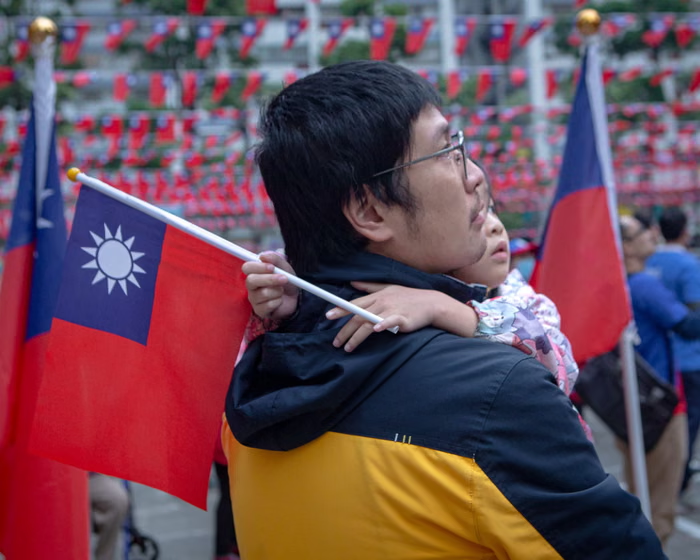
The image of a powerful regional force carrying out a sudden overnight operation to remove the leader of a smaller neighbouring state is one that could not have gone unnoticed in Taiwan.
“The Daily Baku” reports that, on Saturday, the United States disclosed details of a surprise special-forces raid that led to the capture of Venezuela’s president, Nicolás Maduro, who was swiftly transferred to the US and appeared in a New York court on Monday. The speed and decisiveness of the operation immediately sparked debate in China, where commentators drew parallels with a hypothetical assault on Taiwan.
China, home to more than 1.4 billion people and the world’s largest armed forces, has long sought control over Taiwan, a self-governing island of 23 million people located just off its coast. The disparity in power mirrors that between the US – the world’s dominant military power – and Venezuela, a middle-income country of around 30 million people that, like Taiwan, depends on friendly states for its defence.
On Monday, Emily Thornberry, chair of the UK parliament’s foreign affairs committee, warned that the muted international reaction to Washington’s actions could embolden both China and Russia. Nevertheless, analysts suggest that events in Venezuela are unlikely to fundamentally alter Beijing’s approach to Taiwan.
One reason is China’s long-standing position that Taiwan is not an international issue. While Beijing is sensitive to global narratives and pressures other countries to recognise its claims over the island, it does not regard Taiwan as a matter governed by international law. Instead, it frames it as a purely domestic concern. Ryan Hass, a former US diplomat in Beijing and now a senior fellow at the Brookings Institution, noted that China has never restrained itself over Taiwan out of respect for international norms, instead relying on coercive tactics short of open warfare.
Shen Dingli, a prominent international relations scholar in Shanghai, echoed this view, arguing that cross-strait relations fall outside the scope of international law and that the US operation in Venezuela has no relevance for Taiwan.
Similar sentiments appeared on Chinese social media. A popular nationalist commentator on Weibo urged users to stop comparing Venezuela with Taiwan, arguing that the US raid was a violation of Venezuelan sovereignty, while Taiwan was, in Beijing’s view, an internal matter with no meaningful comparison in purpose or method.
A second and more decisive factor restraining Beijing is the military balance in the Taiwan Strait. Although China’s armed forces are stronger overall, Taiwan benefits from an implicit promise of US support in the event of an invasion. Just last week, the People’s Liberation Army staged large-scale military drills around Taiwan, demonstrating its capacity to blockade the island and counter foreign intervention.
According to the US Department of Defense, the PLA is progressing toward its 2027 objective of being able to secure a “strategic decisive victory” over Taiwan, aided by advances in military artificial intelligence, biotechnology and hypersonic weapons.
Yet in Taiwan itself, some observers argued that the Venezuela operation might actually make Beijing more cautious rather than more confident. Attention focused on the failure of Venezuela’s Chinese-supplied weapons to prevent the US strike. Data from the ChinaPower project at the Center for Strategic and International Studies shows that nearly 90% of China’s arms exports to the Americas between 2010 and 2020 went to Venezuela.
Lin Ying Yu, an associate professor at Tamkang University in Taipei, questioned how US forces were able to operate with such apparent ease. He noted that Chinese-made weapons had recently gained prestige following their performance in clashes between Indian and Pakistani air forces, but that the Venezuela raid appeared to challenge that perception.
Sung Wen-Ti, a Taiwan-based fellow at the Atlantic Council’s Global China Hub, argued that the US military’s demonstrated ability to carry out a decapitation strike against a defence system largely built with Chinese equipment should give Beijing pause before testing its forces directly against Washington.
At the same time, Donald Trump’s open disregard for the international rules-based order – and the speed with which many western governments aligned themselves with Washington – highlights a broader erosion of global norms. UK prime minister Keir Starmer declined to condemn the operation, despite legal experts describing it as a breach of international law, and several European leaders offered only cautious responses.
China condemned the raid as a serious violation of international law and, alongside Russia, supported an emergency meeting of the UN security council to examine its legality.
Taiwan’s government chose not to comment on the US action, even though President Lai Ching-te has repeatedly stressed the importance of defending the international rules-based order as a safeguard against Chinese aggression.
Within Taiwan, public debate took a more introspective turn. One widely followed blogger argued that to avoid becoming “another Venezuela”, Taiwan should refrain from actions that could alienate the US, such as becoming a source of instability, drugs or refugee flows. In a Facebook post liked more than 30,000 times, YouTuber Chiu Wei-chieh, known as “Froggy” Chiu, stressed that unlike Venezuela, Taiwan’s leadership enjoys broad public support. “Taiwan must not become Venezuela,” he wrote. “That means standing united and ensuring we are not seen as easy prey.”
© 2026 The Daily Baku. All rights reserved.
https://dailybaku.az/en/article/what-the-us-raid-in-venezuela-signals-for-china-and-taiwan