The Daily Baku
International
Trump warns Caracas of a ‘heavy cost’ if interim leadership defies Washington
January 5, 2026
13:22
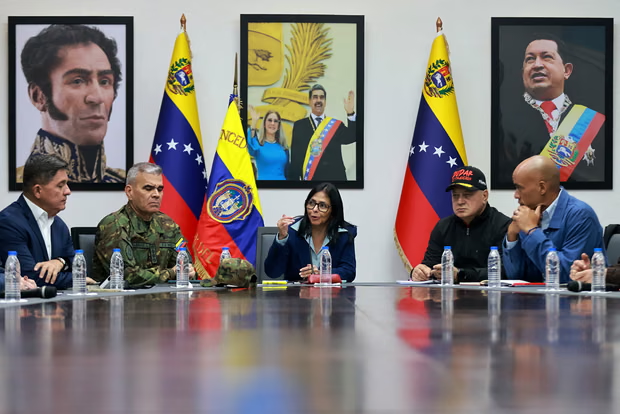
US maintains 15,000 troops in the Caribbean amid fears interim president could obstruct American aims
“The Daily Baku” reports that, the likelihood of the United States taking direct control of Venezuela appeared to diminish on Sunday following the dramatic removal of president Nicolás Maduro, yet senior US officials cautioned that renewed military action remained on the table should interim leader Delcy Rodríguez fail to comply with Washington’s expectations.
Speaking to journalists late on Sunday, Donald Trump also floated the possibility of military operations extending beyond Venezuela, including potential action in Colombia.
After Maduro was seized in a surprise operation early Saturday, Trump initially declared that the United States would effectively “run” the South American nation of roughly 30 million people. By Sunday, however, he warned that a second strike could follow if remaining officials within the Venezuelan government resisted US efforts to “repair” the country.
Rodríguez, 56, who on Saturday had pledged loyalty to Maduro and denounced his capture as an “atrocity,” struck a notably different tone the following day, calling for a “balanced and respectful” relationship with Washington.
“We extend an invitation to the government of the United States to work jointly on a cooperative agenda focused on shared development,” Rodríguez said after convening her first cabinet meeting since Maduro’s removal.
According to Trump, US secretary of state Marco Rubio spoke directly with Rodríguez, who assured him that “we’ll do whatever you need.”
“She was, I think, very polite,” Trump told reporters, “but she really doesn’t have much of a choice.” The New York Times reported that Trump administration officials had identified Rodríguez weeks earlier as a potential successor and pragmatic partner, in part due to her ties to Wall Street and major oil firms.
In Caracas, senior political and military leaders demanded Maduro’s return but simultaneously expressed support for Rodríguez as an interim figure, urging the country to resume normal life.
“I call on the Venezuelan people to return to their daily activities — economic, professional and educational — in the coming days,” defence minister Vladimir Padrino López said in a televised address.
Maduro’s son, Nicolás Ernesto Maduro Guerra, said supporters of the ousted president were more determined than ever, according to an audio message circulated on social media.
“They will not see us weakened,” he said. “President Nicolás Maduro will return. We will take to the streets, mobilise the people and unite.”
Speaking aboard Air Force One, Trump broadened his warnings to include other Latin American nations, suggesting Colombia and Mexico could face US military action if they failed to curb the flow of illegal drugs into the United States.
“Operation Colombia sounds good to me,” Trump said, adding that Cuba — Venezuela’s closest ally — “looks like it’s ready to fall” even without direct US intervention.
Earlier on Sunday, Trump again raised the prospect of intervention elsewhere, declaring: “We absolutely need Greenland.” Katie Miller, wife of Trump’s deputy chief of staff Stephen Miller, later posted an image of Greenland coloured like the US flag with the word “soon,” prompting a formal protest from Greenland’s prime minister.
In a series of television interviews, Rubio sought to downplay fears of an invasion or occupation of Venezuela, while confirming that the US was maintaining a force of roughly 15,000 personnel in the Caribbean.
“There’s no war,” Rubio told NBC. “We’re at war with drug trafficking organisations, not with Venezuela. We don’t have US forces permanently on the ground.”
He said US troops were present in Caracas for roughly two hours in what he described as a “law enforcement operation” that did not require congressional approval. “This was not an invasion, and it was not a prolonged military campaign,” he said.
Rubio added that Washington would continue enforcing a maritime “quarantine” to prevent sanctioned oil tankers from entering or leaving Venezuela, preserving leverage over Maduro’s successor. “We will judge them by what they do, not by what they say publicly,” he said.
He also described Cuba’s government as a “major problem” and “in serious trouble,” without offering further details.
Cuba confirmed on Sunday that 32 Cuban military and police personnel were killed during the US operation in Venezuela, stating they had been deployed at the request of the Caracas government.
Governments including Spain, Brazil, Chile, Colombia, Mexico and Uruguay issued a joint statement warning that US actions “set an extremely dangerous precedent for peace and regional security” and placed civilians at risk. UK prime minister Keir Starmer said Britain had no involvement in the attack but stopped short of condemning it.
All EU member states except Hungary released a statement urging restraint by “all actors” and respect for the Venezuelan people’s will as a means to “restore democracy.”
In Caracas, some shops and cafés reopened, creating a fragile sense of normality as authorities assessed the damage from Saturday’s raid.
Long queues formed outside supermarkets as residents rushed to stockpile essentials, anxious about the future and the possibility — raised by Trump — of a “second wave” of attacks.
“It’s the same everywhere — lines at supermarkets, bakeries, pharmacies,” said a 71-year-old pensioner waiting outside a small grocery store in northeast Caracas. “People don’t know what’s coming, and no one wants a repeat of Saturday morning or to be caught unprepared with an empty fridge.”
In Petare, eastern Caracas, a young couple stood among a line of more than 100 people waiting to enter a major supermarket to buy milk, butter and flour, as staff allowed shoppers inside in controlled groups.
“I feel angry,” said Sauriany, a 23-year-old woman who gave only her first name. “They have no right to interfere like this in another country and do whatever they want,” she said of the US operation.
Across the border in Colombia, unease was also growing. President Gustavo Petro ordered 30,000 troops to the eastern frontier with Venezuela amid fears of violence or a sudden influx of refugees.
Trump described Colombia on Sunday as “very sick” and led by a “sick man,” accusing Petro of producing and exporting cocaine to the US. “He won’t be doing it for much longer,” Trump said.
Asked whether Washington might pursue military action against Colombia, Trump replied: “It sounds good to me.”
Petro pushed back strongly, writing online: “Stop slandering me, Mr Trump.”
“That is not how you threaten a Latin American president who emerged from armed struggle and from the Colombian people’s fight for peace,” he added.
Petro has previously said his government has seized cocaine at record levels and last month invited Trump to visit Colombia to observe efforts to dismantle drug laboratories.
Over the weekend, US authorities unsealed a four-count indictment accusing Maduro of narco-terrorism and conspiracy to import cocaine. The charges also name Flores, their son, two Venezuelan officials and an alleged leader of Tren de Aragua — a gang designated by the Trump administration as a terrorist organisation. Maduro is scheduled to appear in Manhattan federal court on Monday for arraignment.
The White House released footage showing the deposed leader in handcuffs during a “perp walk” to Drug Enforcement Administration offices in New York before his transfer to the Metropolitan Detention Center in Brooklyn.
The prosecution is expected to deepen the sense of humiliation among Maduro loyalists and further complicate the delicate position of his successor.
Rodríguez, who served as vice-president and oil minister before Maduro’s removal, must now balance Washington’s demands for oil access and security guarantees with a political system that still carries elements of the socialist and anti-imperialist legacy of Hugo Chávez.
The Trump administration’s apparent comfort with adjusting the regime rather than replacing it outright has disappointed Venezuelans who hoped Maduro’s fall would lead swiftly to democracy.
Trump dismissed opposition leader María Corina Machado — the Nobel peace prize laureate who helped mobilise Edmundo González’s successful presidential campaign last year — claiming she lacked sufficient domestic support. While millions admire Machado, she remains deeply unpopular among the military leadership that underpins the current power structure.
Rubio said the US wanted a democratic transition but ruled out near-term elections, arguing that leaders of Venezuela’s military and police must first decide their direction. “We hope they choose a different path than Nicolás Maduro did,” he said. “Ultimately, we hope this leads to a comprehensive transition.”
Back in Caracas, joggers and cyclists returned to the streets, though many residents spoke of lingering fear and uncertainty about what lies ahead.
© 2026 The Daily Baku. All rights reserved.
https://dailybaku.az/en/article/trump-warns-caracas-of-a-heavy-cost-if-interim-leadership-defies-washington