The United States has rescued both crew members of the aircraft shot down in Iran: details
President Donald Trump stated that the second crew member of the F-15E fighter aircraft shot down by Iran has also been found safe.
The aircraft was shot down by Iran on April 3 over its territory, near the Arak heavy water reactor, and the crew members parachuted onto Iranian territory. The F-15E aircraft crew consists of two service members: a pilot and a weapons systems officer.
The rescue of the downed F-15E crew consisted of two separate operations carried out under different conditions. The pilot was found on April 3, approximately seven hours after the crash. He was located in the southwestern Kohgiluyeh and Boyer-Ahmad province, near the city of Dehdasht. He was found during daylight by two HH-60W Jolly Green II helicopters in a relatively accessible area.
The weapons systems officer, a senior officer with the rank of Colonel, was found at a greater distance. He either drifted away from the crash site due to wind affecting the parachute or moved intentionally to avoid capture. He took shelter in a mountain crevice south of Isfahan. The two crew members were approximately 150 km apart, which required two separate combat search and rescue operations in difficult terrain.
To rescue the second crew member, U.S. Special Operations Forces established a temporary landing zone in the area, effectively creating a short-term airstrip. They also set up a forward operating base at the airstrip. This base was used to coordinate the rescue operation, deploy personnel, and support air activity for several hours.
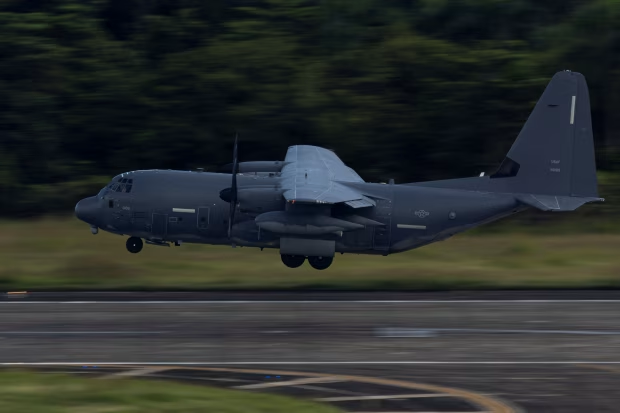
During the rescue operation, two MC-130J transport aircraft and at least one helicopter were lost. According to reports, the landing area was not suitable, as it consisted of soft, sandy ground. As a result, two transport aircraft became stuck in the sand after landing and were unable to take off. These aircraft were destroyed by the United States to prevent them from falling into Iranian hands.
Overall, the operation demonstrates that U.S. forces are capable of operating deep inside Iranian territory. This situation suggests certain limitations in Iran’s rapid response and airspace control capabilities, especially near Isfahan, which is an important area for missile, nuclear, and military infrastructure.
The operation also shows that the United States can deploy and extract special operations forces in central regions of Iran and could, for example, conduct ground-based attacks against underground missile bases. It further demonstrates that, despite technical losses, the U.S. military has the capability to carry out long-range operations and recover its personnel from hostile environments.
The Daily Baku editorial team
© 2026 The Daily Baku. All rights reserved.