The Daily Baku
International
Planned for months, finished in under three hours: how the US seized Maduro
January 5, 2026
16:42
The operation that led to the capture of Venezuela’s president, Nicolás Maduro, and his wife, Cilia Flores, was the result of months of preparation, vast intelligence gathering and overwhelming military force. In the early hours of Saturday morning, it took just two hours and 28 minutes to remove the country’s leader — a dramatic show of US power that has left Venezuela’s 30 million citizens facing deep uncertainty.
“The Daily Baku” reports that, at the heart of Operation Absolute Resolve was extensive work by the CIA and other US intelligence agencies. From as early as August, analysts focused on mapping Maduro’s “pattern of life” — a comprehensive effort to track how he moved, where he slept, what routes he used, and even details of his daily habits. As General Dan Caine, chair of the US joint chiefs of staff, put it, the objective was to understand every aspect of the president’s routine.
As Washington expanded its military presence in the Caribbean from September onward, Maduro responded by dramatically tightening his personal security. Public appearances were curtailed, speeches were abandoned, and he rotated between six and eight overnight locations to avoid being tracked. He also leaned heavily on Cuban intelligence operatives and non-Venezuelan bodyguards, banning local security staff from carrying mobile phones.
These precautions ultimately failed. By Friday evening, with weather conditions finally suitable for action, US intelligence had confirmed Maduro’s location at a compound inside Fuerte Tiuna, Caracas’s most important military base.
Surveillance drones played a key role in tracking Maduro, but after the operation the CIA also disclosed — unusually — that it had a human source within the Venezuelan government. The revelation was striking, as it risked exposing an asset, but may also have been intended to undermine confidence within Venezuela’s remaining leadership.
By November, as many as a quarter of the US Navy’s surface fleet had been deployed to the Caribbean, reinforced by the arrival of the USS Gerald R Ford, the world’s largest aircraft carrier, carrying roughly 4,000 personnel. Despite this visible buildup, the military’s goal on the night of the raid was to achieve surprise and complete air superiority.
The final authorization came from President Donald Trump at 10:46pm eastern time. The first phase involved dismantling Venezuela’s air defences to create a safe corridor for helicopters carrying elite Delta Force units tasked with extracting Maduro.
Although Venezuela possessed one of the region’s stronger militaries — including Russian-made Su-30 fighter jets and advanced S-300 and Buk air-defence systems — these capabilities proved ineffective. US strikes quickly neutralised radar, airbases and command centres, reportedly using Tomahawk cruise missiles and AGM-88 anti-radiation weapons. F-35 jets were also said to have destroyed Venezuelan aircraft on the ground. In total, more than 150 US aircraft took part.
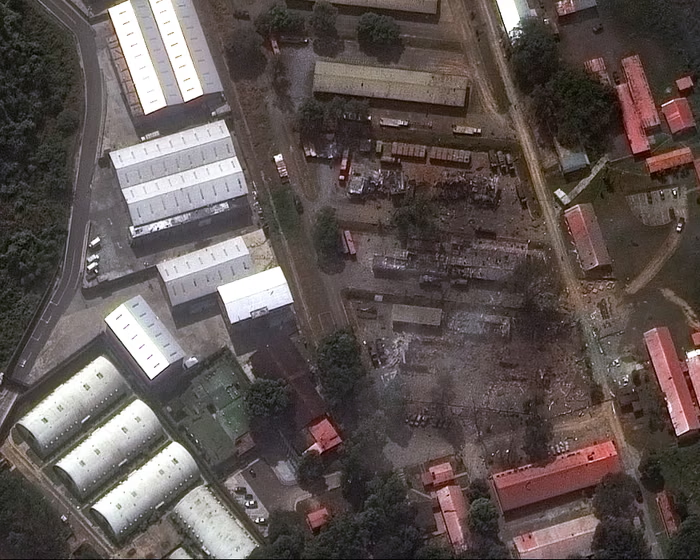
Trump later claimed that power outages in Caracas were the result of US technical expertise, hinting at cyber operations. Residents did report blackouts following the first explosions, and satellite imagery showed damage to a power facility at Fuerte Tiuna, though it remains unclear whether the outages were caused by cyber activity or conventional strikes.
Delta Force helicopters flew at extremely low altitude to avoid radar detection, skimming just above the sea before crossing the mountainous terrain separating the coast from Caracas. Footage later emerged showing nine helicopters — modified Black Hawks and Chinooks — flying unchallenged into the capital.
As they approached Maduro’s compound shortly after 2am, the helicopters came under gunfire, damaging one aircraft but failing to halt the assault. US forces had rehearsed extensively, even constructing a full-scale replica of the compound in the United States. Equipped with cutting tools and supported by an FBI hostage negotiator, the team was prepared for multiple contingencies.
The raid unfolded largely as planned. Firefights erupted on the ground, and Venezuelan officials later said dozens of people were killed nationwide, including many of Maduro’s security personnel. No US troops were killed, though several were injured.
In his final moments in office, Maduro attempted to flee to a secure room but was intercepted before he could seal the door. Trump later remarked that the president was overwhelmed almost immediately.
By 4:29am, the helicopters were already on their return flight, escorted by fighter jets, carrying Maduro and Flores out of Venezuela. They were initially transferred to the USS Iwo Jima, marking the end of the operation less than three hours after it began.
From a purely military standpoint, the mission was a clear success — a stark demonstration of US capability. Whether it will translate into political control or lasting change in Venezuela remains uncertain. As Matthew Savill of the Royal United Services Institute observed: “They’ve removed a couple. It’s impressive, but it’s not the same as dismantling a system.”
© 2026 The Daily Baku. All rights reserved.
https://dailybaku.az/en/article/planned-for-months-finished-in-under-three-hours-how-the-us-seized-maduro