How Russia’s Cheaper Sanctions Workarounds Hit Armenia’s Illicit Sanctions Trade
For several years, Armenia was accused of actively benefiting from sanctions-driven re-export flows after Western restrictions were imposed on Russia. By 2025, however, Armenia’s foreign trade entered a phase of sharp correction, and a closer look at exports and imports separately helps explain what has changed—and what has not.
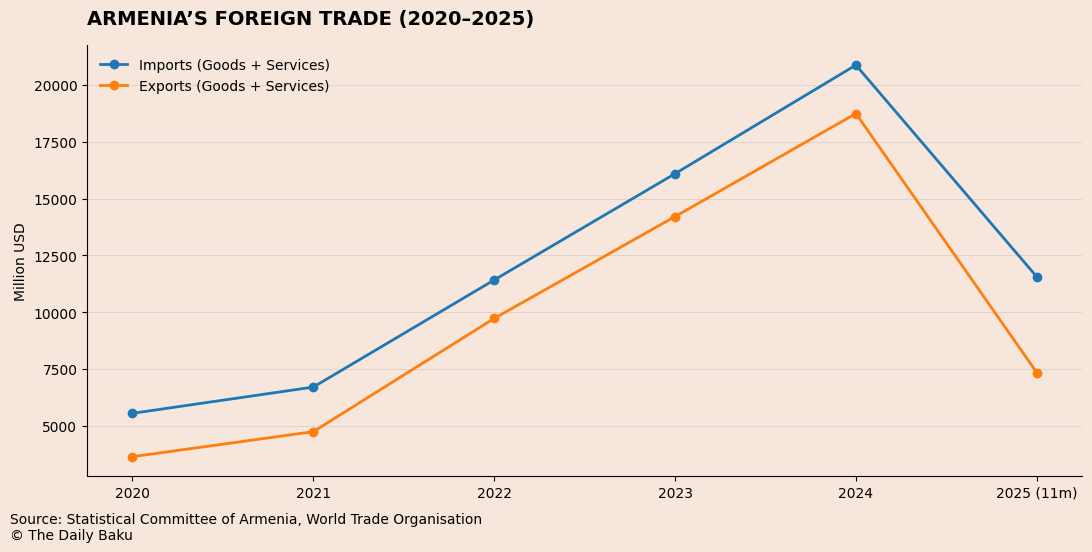
Exports provide the clearest evidence that the earlier boom was partly artificial. In January–November 2025, Armenia’s total exports fell by 40.6% year-on-year, to $7.35 billion. Exports of precious and semi-precious stones and metals—the category most closely associated with re-export and processing schemes—plunged by nearly 70%, to $2.3 billion. In contrast, exports of food industry products increased by almost 25%, mining products by 15%, and instruments and devices by 46%. These figures indicate that Armenia is trying to offset its losses from sharp decline of sanctions evading business by channeling its domestically produced goods to European markets at higher prices.
Imports tell a similar story from the other side of the trade balance. Total imports fell by 27.4%, to $11.56 billion, with imports from Russia down by more than 50%. This sharp drop mirrors the decline in exports of precious metals and stones, which also fell by 70% on the import side, confirming that a major transit loop for sanctions evading has been disrupted.
Against this background, the increase in exports to Belarus stands out and has raised questions. Armenian exports to Belarus rose by more than 40% in 2025, even as overall exports declined sharply. On its own, this growth is not large enough in absolute terms to offset the collapse elsewhere, but it is politically sensitive given Belarus’s close economic and military ties with Russia and its own exposure to Western sanctions.
The overall collapse of precious metals trade, which had been the core of sanctions-related re-export activity, indicates that Armenia’s capacity to act as a large transit hub has diminished significantly.
This decline occurred not because Armenia chose to comply more strictly with sanctions, but because Russia identified cheaper and more efficient ways to circumvent them, building a broad network of alternative trade routes—primarily centered on Chinese supply chains—which significantly reduced the need to use Armenia as a transit hub. Nevertheless, Armenia tries to devise new routes to benefit from lucrative sanctions evading business.
The Daily Baku Editorial Team
© 2026 The Daily Baku. All rights reserved.