The Daily Baku
International
Germany’s far-right AfD invited to attend Munich Security Conference 2026
December 30, 2025
16:32
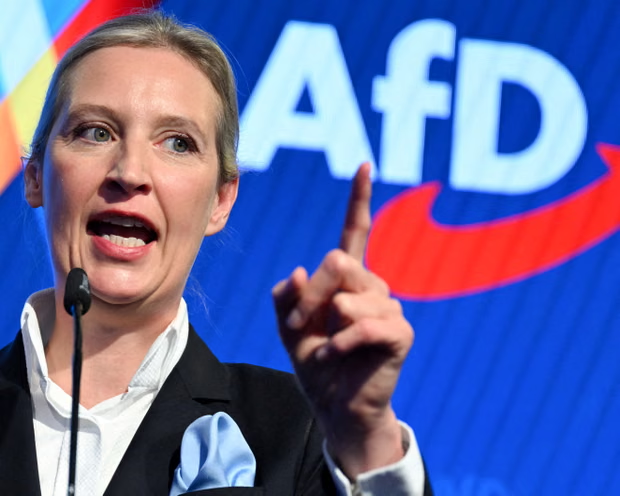
Decision follows criticism from JD Vance after party’s exclusion over the past two years
The Munich Security Conference (MSC) has extended invitations to lawmakers from Alternative für Deutschland (AfD) to take part in its annual February gathering of senior international defence and security figures, ending a two-year period in which the far-right party was excluded, The Daily Baku reports.
Organisers confirmed the policy shift after the US vice-president, JD Vance, sharply criticised the AfD’s exclusion during a forceful speech at this year’s conference, accusing Germany of suppressing free expression by marginalising the anti-immigration, pro-Kremlin party.
An MSC spokesperson declined to give a detailed explanation for the change, stating only that the conference, which has taken place in Munich since 1963, is organised by a “private, independent foundation” and is “under no obligation to anyone when issuing invitations”.
“It was decided to invite members of parliament from all parties represented in the Bundestag,” the spokesperson said, highlighting in particular MPs serving on the foreign affairs and defence committees. “This same principle was applied prior to 2024.”
Approximately 10 AfD lawmakers currently sit on the Bundestag’s foreign affairs committee, with a further nine serving on the defence committee.
When asked whether Vance’s remarks influenced the decision, the spokesperson responded: “The MSC independently determines who is invited to its events.”
Vance had previously caused controversy by holding a meeting on the sidelines of the MSC with AfD co-leader Alice Weidel just days before Germany’s general election in February, after declining an invitation to meet then chancellor Olaf Scholz.
Weidel said she had not yet received an invitation to the 2026 conference, though organisers noted that the guest list remains “incomplete”. Her party has long sought to strengthen ties with Donald Trump’s Maga movement.
The MSC traditionally brings together heads of state and government, foreign and defence ministers, and senior military officials from around the world for a weekend of public speeches and closed-door discussions.
The earlier policy of excluding the AfD was introduced under the previous MSC chair, Christoph Heusgen, a longtime adviser to former chancellor Angela Merkel. Since then, leadership has changed: former Nato secretary general Jens Stoltenberg has been appointed as the new chair, though while he completes his term as Norway’s finance minister, the role is being filled by Wolfgang Ischinger, a former German ambassador to the US and UK and a longtime figure at the conference.
Ahead of the MSC’s announcement, Alexander Hoffmann, parliamentary leader of the Christian Social Union (CSU) — the Bavarian sister party of Chancellor Friedrich Merz’s Christian Democratic Union — warned against inviting the AfD, citing close ties between some of its members and Russia and China.
“Information flows in such settings, and that is why it would represent a security risk,” Hoffmann told the dpa news agency.
Kai Arzheimer, a political scientist at the University of Mainz, said Ischinger’s rationale for the move was difficult to interpret.
“Perhaps he genuinely believes this will prevent further interference from the US government,” Arzheimer said. “A more pessimistic reading is that this marks another step toward normalising the party, with some institutions already anticipating AfD participation in government.”
Political consultant Johannes Hillje argued that without an “official explanation” from the MSC, the decision “appears to be a capitulation to JD Vance and his criticism of the AfD’s exclusion”.
Hillje said the AfD “is more extreme than other western rightwing populist parties, which is why the German state cannot treat it like a normal party”. He added that if AfD MPs attend the main conference, they should be barred from “sensitive side events” that could grant access to “confidential information” potentially shared with “contacts in Russia”.
By contrast, Thorsten Benner, director of the Berlin-based Global Public Policy Institute, noted that the MSC regularly hosts “large Chinese delegations” without controversy and did not view the participation of AfD MPs in the main conference as a security threat.
“The MSC sees itself as a forum with a strong Republican presence,” Benner wrote on the social media platform Bluesky. “Ultimately, it is wiser not to give Vance and the AfD the opportunity to portray themselves as victims.”
The Guardian understands that the invitation extended to AfD lawmakers applies only to the main conference and excludes other “confidential formats” organised by the MSC.
The MSC’s reversal comes amid an intense debate in Germany over how to respond to the AfD’s growing influence. The party secured more than 20% of the vote in the most recent federal election, becoming the largest opposition force in the Bundestag.
A long-standing “firewall” has prevented mainstream parties from cooperating with the AfD at both federal and state levels. However, five regional elections are scheduled across Germany in 2026, and the AfD currently leads opinion polls in two of them.
In May, Germany’s domestic intelligence agency classified the AfD as a “confirmed rightwing extremist” organisation, though the designation remains under formal review.
© 2026 The Daily Baku. All rights reserved.
https://dailybaku.az/en/article/germanys-far-right-afd-invited-to-attend-munich-security-conference-2026